
It can be difficult to recover from hoarding because of the emotional reasons for hanging on to all your stuff. Try these tips for preparing to get organized.
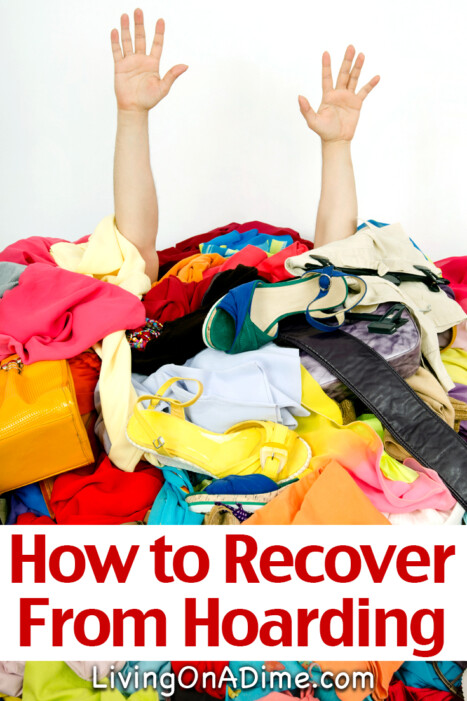
How To Recover From Hoarding – Getting Organized
Thank you so much for your blog! I have already learned some helpful hints. I am such a messy housekeeper, always procrastinating because it seems so overwhelming. I tell myself, “Oh, it’s too much to start today. I’ll do it when I have more time.” My parents are big hoarders who never part with anything so I never really learned how to keep a clean home. I do keep the dishes and clothes washed and I make sure things are sanitary.
I just have too much stuff. I’m a pack rat. There is stuff everywhere in plastic containers and in drawers. I have enough clothing to dress all of the neighbor women for a couple of weeks each. This stuff is mine and I see a use for all of it. I just can’t bring myself to throw away any of it. I like it all!
I really wish every space in my house wasn’t a collect-all. We don’t even get to sit at the table as a family. My husband complains, we hate to have unexpected family, we eat out because there is no space on the counter to cook, important papers get lost and we buy more stuff because so many things get misplaced. Everyone passes the blame on someone else. To top it all off, we live in a small ranch home with little closets.
How will I ever overcome all of this hoarding? I want to live like the normal tidy person– Stuff is ruining MY LIFE. Can you give me any suggestions about where and how to start?
It’s challenging to provide a precise answer with limited information, but I’ll do my best to guide you in the right direction. Since I’m addressing the entire group, some points may not apply to your specific situation, but I’m including them in case they’re helpful to others.
How to Recover From Hoarding:
- If you’re dealing with hoarding tendencies, try approaching organization as a team effort. While hoarding often stems from one person’s challenges, it impacts the entire family—making it an issue everyone can help address. Consider holding a family meeting to discuss the situation and explore how everyone can contribute to creating positive, lasting change together.
- Address the emotions behind hoarding. When people do anything extreme, including hoarding, there are often unresolved emotions manifesting in the extreme behavior. Many people turn to “stuff” as a way to feel better, more secure, or more loved, but this approach can backfire. In some cases, there’s a history of serious emotional trauma, leading people to try to fix emotional pain with physical possessions. Unfortunately, this doesn’t work and often creates more problems. In your case, you have to go out to eat, can’t have people over, can’t find your bills and so on.
If you came across a man dying of thirst in the desert you wouldn’t hurry over to him, give him a great big hug, tell him he is loved and expect that to fix his problem. His problem is a physical one – he needs water.
People often have an empty emotional gap in their hearts and they think “stuff” will help fill that emotional gap. It just won’t work. You need to solve emotional problems with emotional solutions, just as physical or spiritual challenges require their own specific remedies. We often mix these up so take an honest look at your life and identify the real root of the problem.
Sometimes people are angry or rebelling because their parents were too strict about keeping the house clean. For others, the issue may simply be overwhelm—feeling stuck and unsure of where to begin. Acknowledging what’s driving your clutter is the first step toward meaningful change. - Our site is packed with detailed, step-by-step articles about how to get organized and clean and also how to tackle the overwhelming feelings, and find the motivation to start. I’ll include two helpful articles at the end of this post to get you started. Take an hour to read them, along with a few other recommended resources on our site—but don’t spend too much time just reading.
It’s easy to fall into the trap of over-researching, which can create a false sense of progress while actually delaying action. Remember, reading is a starting point, not a substitute for taking real steps toward change. Stay focused, and don’t let preparation become procrastination! Be careful not to get caught in that trap. - Consider asking a friend or family member who is naturally organized to help you tackle the clutter. Don’t be afraid to reach out—if you’re serious about getting organized, it’s important to set aside emotions like fear or embarrassment and focus on the task at hand.
You might be surprised to find that many organized people genuinely enjoy helping others get organized. Speaking from experience, when I walk into a messy room, my fingers practically itch to start tidying up! It’s not about judgment—I just want to help. You may find others feel the same way, so take that first step and ask for support. - Put on some comfortable clothes and some pleasant music and get started. After you have finished reading this article and the others you will hopefully be mentally and physically prepared to just get up and do it. You may want to spend a day getting yourself and the “troops” ready or you might clean off just one section today, like your kitchen table. The important thing is to get up and move.
Getting Motivated
There is more detail about this next point in the articles linked below but I will briefly mention it here. One thing that helps me get rid of things is to know that there are people out there who really really need the things I am just storing.
I have been on the other side. When I had my second baby I only had one dress to wear and it wasn’t even a maternity dress. I had to wear a dress four or five times a week and it was embarrassing to have to wear the same thing over and over. I had a neighbor who decided to get rid of some of her stuff and she gave me a whole wardrobe full of clothes. It meant so much to me that I wanted to sit down and cry. This has happened to me many times over the years.
Now I look at my closet full of clothes and, even though I do wear most of them, I ask myself, “Do I really really need that many clothes? Maybe someone else could use them more.” Even though we do wear that pair of black pants once every six months, do we really need to keep it when we have five other pairs of the same type?
You mentioned that, as a result of your hoarding, you often eat out, lose important papers, and struggle with other issues that end up costing you money.
Imagine how much of that wasted money you could save—and even use to help someone else—if things were more organized.
I don’t mean to sound harsh, especially since it’s clear you’re really trying. But consider this: If a child was clutching an armful of toys in a room with another child who had nothing, what would you think if the first child said, “I want all of my stuff and I don’t care that the other child has nothing. I’m not going to share or give up my toys because they make me happy and feel good.” That might seem selfish, right? Yet, we often practice a grown up version of this without thinking about it.
Sometimes, the little girl clinging to her toys might give away one toy — but the sad thing is she doesn’t realize that clinging to that many toys is not giving her the true happiness she thinks it is. While she is holding tightly to the armful, she can’t really play with any of them or enjoy them properly.
She hasn’t learned that by sharing, giving and sacrificing she will step into a whole new world of joy and happiness that giving and sacrificing brings, not to mention the relief she will feel when she gets rid of the heavy burden that comes from carrying around and managing all of those things. How much easier is the little girl’s burden if she only has one toy to hold instead of juggling an armful.
Many people who declutter say they didn’t realize how much of a burden their stuff had become until they let it go. They describe it as having a heavy weight lifted off their shoulders. You said it yourself—your stuff is overwhelming you. That’s not a good feeling.
Now it’s time to get up and, with a little discipline and work, get it done. Do it in stages if that helps but get it done. Discipline and effort might seem hard at first, but ask yourself: Are they really harder than living with the overwhelm you’re feeling now?
You can do this! You sound like you are now at the point where you really want to get it decluttered, organized and cleaned up — and that is half the battle! Read these articles for extra motivation, and before today ends, get up and at least clean off your kitchen table.
A Most Wonderful Treasure – This is more of a motivational article you might want to read first.
For lots of helpful tips to make organizing, cleaning and laundry easier, go get our How To Organize And Clean Your Home e-books now!


 Clean and Organize in Five Minutes!
Leave a Reply