
Does Vinegar Disinfect as Well as Bleach? Some people are afraid of bleach and prefer to use vinegar as a disinfectant but is it as effective?
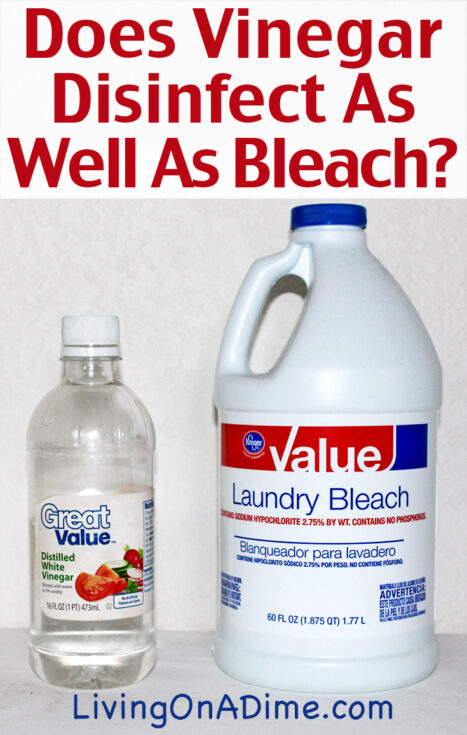
Does Vinegar Disinfect As Well As Bleach?
When mom mentioned that you should disinfect your countertops with bleach we received a lot of comments about how great it is to use vinegar instead of bleach.
So, let’s set the record straight.
We do not want to knowingly put incorrect or dangerous information on our website. so in situations like this we will refer to the best places we know to get the correct information. That’s why, in cases like this, we look to trusted sources—usually government health agencies. Also even the sites who recommend the use of vinegar admit that the testing for it is very unclear because it hasn’t been thoroughly tested like bleach.
Regarding vinegar working as well as bleach, vinegar is NOT as effective as bleach and does NOT kill as many germs. While vinegar does have some disinfecting properties, it is only 90% effective against bacteria and 80%-83% effective against viruses and mold/mildew. This means when you use vinegar as a disinfectant, you are putting your family at risk.
Bleach kills 99.9% of bacteria, viruses and mold/mildew. This information came from the health department. I encourage you to contact your local health department to confirm if you don’t believe these statistics.
There are a lot of rumors and conspiracies about bleach that people worry about, but isn’t it wise to really look at the facts rather than using products that are unsafe as disinfectants? Don’t let emotional fear from people spreading rumors online cause you to make poor decisions.
Another thing to consider is that using soap and water kills more germs than vinegar so, unless you are trying to get rid of soap scum, residue or mineral build up in laundry, why are you even messing with vinegar?
We are not suggesting that you use an entire gallon of bleach every day to clean your home. I wash whites two times a week using bleach. I generally disinfect every few days to a week or once a day when there is sickness in the house. A gallon of bleach lasts me 3-4 months! People say they can’t clean with bleach because the fumes take their breath away. If this is happening, it is usually not the bleach. Many people simply use way more bleach than they should. I also have to ask– Has no one smelled vinegar lately? The smell from it really takes my breath away and burns my nose.
I know there are people who believe that illnesses have increased because people are using products line bleach and other disinfectants. I have to say that I do not agree and think that we should be thankful that we have products that kill life threatening bacteria and viruses now.
I once heard a person from Africa say, in response to people who want to ban pesticides, “You rich Americans want to try and force us to stop using pesticides, but you aren’t dying from the diseases that these bugs carry.”
I think the same is true with the use of bleach. It has been 60-70 years since a lot of people were dying from major illnesses that are preventable. This generation has not had to go through the pain of losing family members to these diseases so many people haven’t heard the stories and aren’t often reminded about how very lucky we are to have things like bleach and pesticides.
Find our easy Homemade Clorox Disinfecting Wipes Recipe Here!
If you are concerned about bleach and the environment, you might want to check out these facts from Clorox.com:
- Household bleach is derived from sodium chloride, also known as common table salt.
- Clorox® Bleach begins and ends as salt water: 95–98% of household bleach quickly breaks down into salt and water, while the remaining byproducts are effectively treated by sewer or septic systems.
- No bleach gets to the environment. Studies have shown that dioxins are not produced when sodium hypochlorite bleach is manufactured, used in laundry or in household cleaning.
- The main ingredients in Clorox® Regular-Bleach are sodium hypochlorite, a form of salt, and water. There is no free chlorine in Clorox® Regular-Bleach.
Most people simply use too much bleach when cleaning. Here is the proper way to clean with it:
If you are going to use bleach in your dishwater, make sure that your soap can be mixed with bleach. Look on the back of the bottle to make sure it doesn’t say “Do not mix with bleach.” Some of the new scented dish soaps will set off toxic fumes if mixed with bleach.
To disinfect correctly, follow these directions from Clorox:
- To Disinfect Surfaces: Use 1/4 cup bleach to 1 gallon of water, or as directed on the label, to disinfect hard, nonporous surfaces in your home.
- To Disinfect Water: If you need to purify water during an emergency, (and don’t have the means to boil it for 3–5 minutes), you can disinfect your water using bleach:
- For clear water—add 8 drops (1/8 tsp.) of bleach per gallon of water
- For cloudy water—add 16 drops (1/4 tsp.) of bleach per gallon of water
Mix the solution thoroughly and let it stand for about 30 minutes before using it. Properly treated water should have a slight chlorine odor. If it doesn’t, repeat dosage and allow water to stand an additional 15 minutes. The treated water can be made drinkable by pouring it between clean containers several times.
[dining]


 This Easy Pound Cake Recipe Is Irresistibly Moist And Delicious!
Leave a Reply